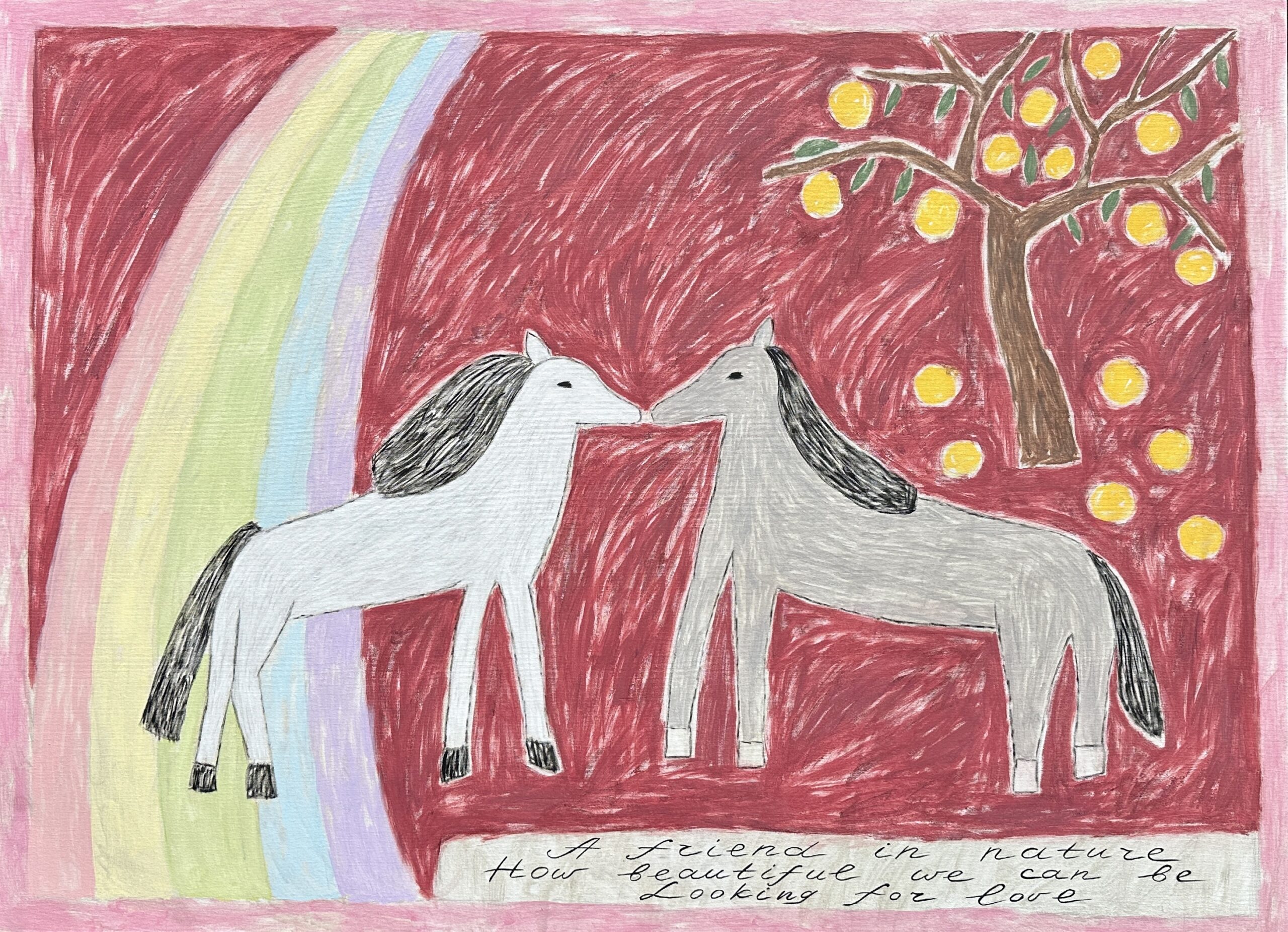
Alexandra Ravska, Horse tenderness.
Tempera, acrylic/canvas
95 × 130 cm
2024
This exhibition presents three artists with roots in countries that are democracies currently under pressure, Azerbaijan and Ukraine. As relatively newly established artists in Södertälje, it is also artistry with a unique gaze at our common society. The artistic work is an opportunity for us to gain insight into the challenges of the times we live in. Art accommodates many voices, shows the world from multiple perspectives, is social and collective – borderless and anarchic. It is democratic. But what is democracy?
Democracy roughly means popular rule, or the power of the people. Art in its broadest sense welds society together and keeps democracy alive. We know this, but we have become increasingly poor at explaining how. What would a city or a society be without art, music, performances, theatre, and exhibitions? Art and democracy are deeply intertwined: art is a democratic right that declare freedom of expression and diversity, functions as a tool for social criticism and reflection. One step to build community by enabling imagination, empathy, and new perspectives. Crucial steps for a vibrant democratic society, even if the balance between political control and artistic freedom always is a challenge. Art orients itself between freedom, equality, society, hope, and oppression.
Alexandra Ravska’s works often engage with themes of interconnectedness between humans, nature, and time, emphasizing fragility, care, and responsibility rather than dominance. A healthy nature where our actions lead to think in cyclical terms is a fundamental prerequisite for human well-being and thus for a functioning democracy. Alexander Ravskyi’s work revolves around this re-examination of our relationship to all living things, considering the idea of continuity and interrelation of all existence. The idea that all living things have a soul and can thereby be resurrected in another form is found not only in ancient Eastern philosophy but also in early European theories, starting with Pythagoras’ “great cyclical” theory, which primarily refers to his cyclical argument for the immortality of the soul. It describes an eternal oscillation between life and death where souls are reborn from the dead, as well as his theory of a cyclical development of society where states decay in an orderly sequence (aristocracy to tyranny). Strangely enough, there is much in today’s social climate that seems to believe that the development of culture benefits from more prohibitions, narrower frameworks and fewer dreams.
Thoughts about social development and democracy as concepts in constant motion are thus nothing new. When Plato imagined the perfect society, he was careful to explain that it had no place for poets and artists – this can be interpreted as the poets and artists teaching citizens to think differently, that they use their imagination to dream alternative worlds. Imagining a different order is thus a threat – when it comes to LGBTQI issues or resistance to full-scale invasion. Elli Asker’s works articulate a quiet yet insistent resistance through the body. Rather than depicting protest, the works inhabit moments of restraint, vulnerability, and withheld expression, revealing how social norms regulate whose bodies are granted full democratic visibility. Through a queer lens, Asker examines what it means to exist, desire, and be seen on equal human terms in a society where fundamental rights are unevenly distributed.
Many envisage parallels between the European society of the 1930s, and emerging authoritarian movements in our time, where much of the common extreme is to limit democratic expressions. Art gives us new thoughts about context and perspective. As viewers, we try to understand these movements as spectators – it creates discussions, debate, sometimes contradictions and demonstrates resistance. Democracy has not closed, but in many places around the world and our immediate area -in very challenging times.
Creating artistic representations, hopes and dreams of a different world challenges the prevailing social order. Art thereby shows a possible common society – a democratic work that we as exhibition visitors generously take part in. With hope for a more diverse future!
Welcome!
Maja-Lena Molin, Artistic Director Södertälje konsthall.
Video by Art Notes