
Foto: Bilder från Centre Culturel Allemande, Paris.
There is quite a lot of material in the Södertälje Konsthall archives related to the retrospective exhibition of Peter Weiss’s art that was shown in the autumn of 1976. Correspondence between various institutions, galleries, private individuals, photos, reviews and a catalogue produced by the Konsthall have been preserved. The driving force and producer of the exhibition was the then Konsthall director Per Drougge. The exhibition took shape through close collaboration and friendship between the two gentlemen.
Per Drougge’s intention was to highlight the visual artist Weiss in a retrospective exhibition covering the years 1933–60. In his analysis of Weiss’s visual art, Drougge traces the author and playwright who took over after the time span that the exhibition covered. From the exhibition catalogue, Per Drougge’s foreword:
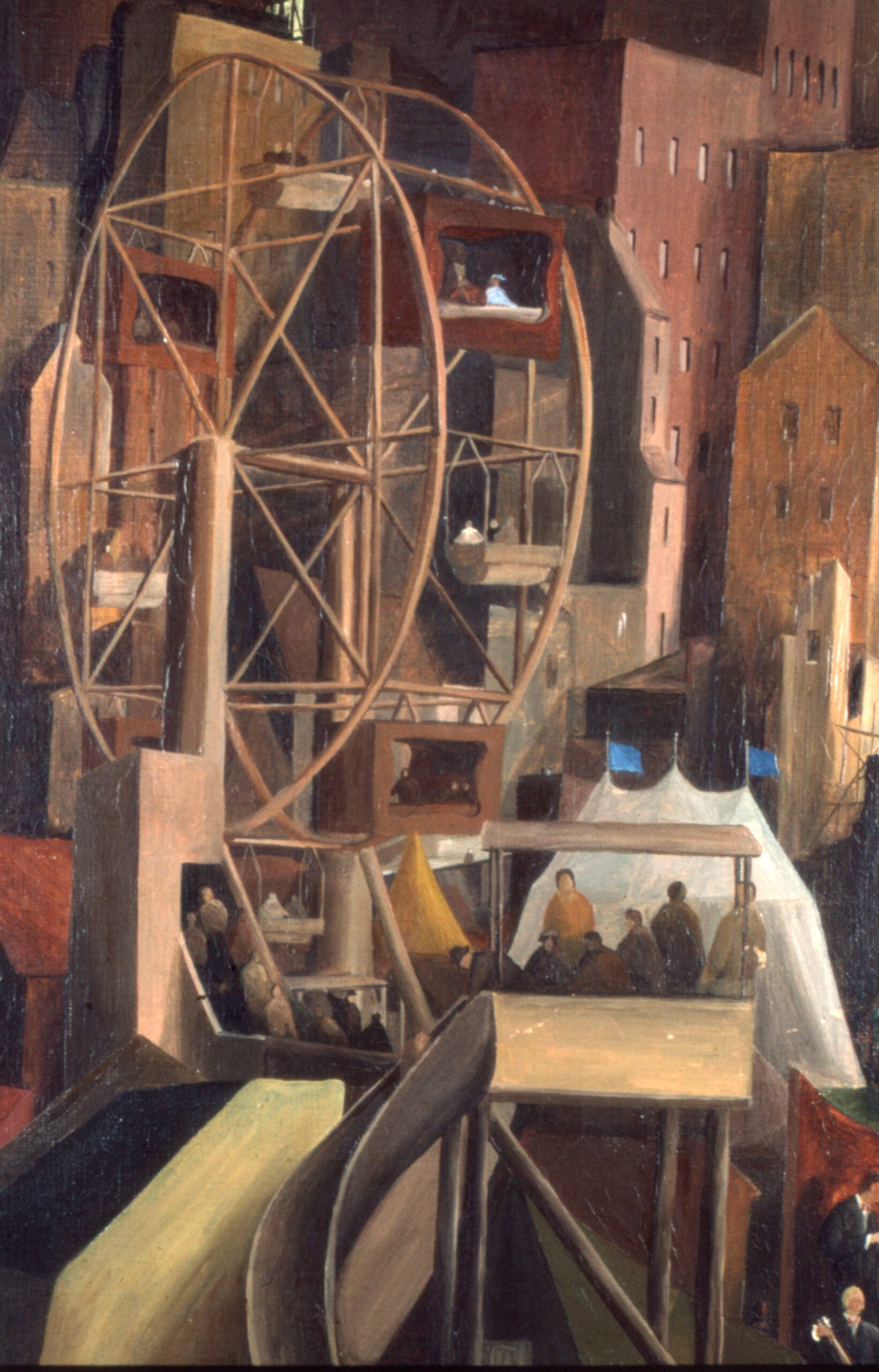
What is striking in the paintings of the teenager Peter Weiss is both a precocious psychological insight into images of people – “People in trams 1 and II (1934) and a personal and unique imagination in creating forms – “Mysteriespel” (1934). Here is already the seed of the playwright Peter Weiss, a seed that would slowly germinate over a couple of decades and then emerge with force and speed in a richly branched writing. The 20-year-old Peter Weiss’ wonderfully beautiful printed and illustrated manuscripts show that his verbal and visual imagination went hand in hand from the beginning and were largely equal sides of a rich personality.


Foto: från Akademin Der Künste Der DDR, fotograf Christian Kraushaar.
A press release from Malmö Konsthall summarises Per Drougge’s words:
In the mid-1930s, in the paintings of the teenager Peter Weiss, a psychological insight into the image of man and a unique gestalt-creating imagination developed. When you see these paintings and his later collages, you understand the origin of the author and playwright Peter Weiss’ specific visual sense.
Weiss was also active as a filmmaker in a transitional phase between visual art and drama. In a letter to the Akademie der Künste, Drougge writes
In the fifties Weiss found a combination of poetical and pictorial expression in film-making, which resulted in a series of avant-garde films – in connexion with his paintings, drawings and especially to his collages, but also in documentary films from the life of beachcombers, alcoholics, drug addicts and prisoners.
The then 700 m2 art gallery was located on one street level and one basement level, at Järnagatan 22 in central Södertälje. Here, 196 of Peter Weiss’s works were shown in a solo exhibition. They included oils, gouaches, watercolors, drawings, inks and tempera paintings, as well as the later collages from the 1960s. The exhibition was insured for a value of 500,000 kronor. In the art gallery’s catalogue, you can see estimated values for each individual work in pencil notes.


Foto: från utställningen i Rostock, fotograf Egon Fischer.
There is only one work in the Södertälje Art Gallery’s collection by Peter Weiss. It is “Parad”, a tapestry that is a replica of a small drawing/watercolor that Weiss made in 1945. The work is currently deposited at the Allaktivitetshuset in Saltskog in Södertälje. The majority of the works shown at the art gallery were produced in Sweden.
In 1934, Weiss moved to England and lived there in various places. He had his first exhibition, quite original, in a garage in London. He studied at the Academy of Fine Arts in Prague from 1936–38, and then came to Sweden as a refugee from the Nazis with a Czech passport in 1939, in connection with the occupation of the Sudetenland. His father Eugen was of Jewish descent. The family settled in Alingsås where his father had contacts in the textile industry. He took up the position as director of Silfa Fabriks AB, which became the country’s largest film printing company. He also started his own company, Eugen Weiss Textile Printing. Peter Weiss moved to Stockholm in 1940 to make a living as an artist. He lived here for the most part until his death in 1982.
The ambitions were quite high and a tour plan was made to reach out with the production as a traveling exhibition in Europe. The archived correspondence includes a variety of letters between Drougge and a number of institutions around Europe, Akademie Der Künste Berlin, the Goethe Institute Bordeaux, Munich, the Swedish Embassy in Bonn to name a few. It is clear from a letter to Per Drougge from Malmö Konsthall’s then director, and former director of Södertälje Konsthall, Eje Högestätt, that the exhibition came there from Zurich to open in August 1978. In a letter to Eje, Per Drougge writes about his experience of the public success to that point.
The Weiss exhibition is not least grateful to the university audience: film and drama students, Germanists and literary historians, art historians. In addition, political interest is added through the book “The aesthetics of resistance”, the second part of which will be published in German in the autumn.
From the Nunsku Committee for exhibitions of contemporary Swedish art abroad, Weiss receives 5,000 kronor in grants to hold an exhibition in the GDR. There were hopes of a strong exchange with the then Federal Republic. However, the response seemed to have been slow according to the then cultural attaché in Bonn, Karin Lindgren. She writes in a letter to Drougge:
The placement of the Peter Weiss exhibition in the Federal Republic has unfortunately not gone particularly well, even though there was latent interest from the beginning. The responses have been dismissive or none at all. I am very sorry for this, since the exhibition would have opened up broad perspectives for discussions.


She further writes that the Bochum Museum in Heidelberg stands by its decision to show the exhibition. A series of photos from the Akademie Der Künste DDR signed Christian Kraushaar are preserved. From the Künsthalle Rostock DDR there are two photos signed Egon Fischer dated November 76. In Rostock the exhibition was opened in connection with Weiss’s 60th birthday.
The committee also decides that the Weiss exhibition will be shown in the Centre Culturel Suédois gallery in parallel with the Centre Culturel Allemand in Paris in the autumn of 1977. From the opening at the latter there are two photos dated 28 September preserved in the archive.
In the letter from Drougge to John Walldén at the Swedish Institute dated 17/8 1977 we get a summary of where the exhibition has been shown so far. It also appears that the exhibition is planned to be shown in several places in Italy and then land in Zurich. After that the exhibition will return to Sweden to be shown at Malmö Konsthall. Amos Andersson in Helsinki saw obstacles in the way of high costs and hesitated to take the exhibition to Helsinki.
A memoriam was written about Peter Weiss by Per Drougge. It states that Weiss gave Drougge the task of writing about him. “We spoke the other day and you gave me an assignment, which delighted me – to write about your visual art/…/. A task that Drougge took on with great enthusiasm. A draft of the book has been preserved, says his son Erik Drougge. The work he did not complete when Per Drougge died in 1991, only 62 years old. Perhaps a basis for future research to tackle? Per Drougge was known and appreciated by the art public for his charismatic and empathetic exhibitions. Erik sums it up nicely in a few words when he visited his father and attended one of his exhibitions.
‘- In 1991, the Moderna Museet had an exhibition with Peter Weiss. I visited my father when he was showing the exhibition, unfortunately it was his last exhibition. I was happy and proud of my father’s ability to describe and bring Peter’s paintings to life.’
Contact us for further information.
Sources: Södertälje konsthall’s archive, Erik Drougge. Text: Anneli Karlsson